Nymphenburg
Nymphenburg Palace: Opening Hours, Tickets, Park and Museums
Seven sites, several ticket desks, two seasons. What the ticket really covers, and when the combined ticket stops paying.
Prices and opening times last checked
From the outside it looks like one building. It works like 7 separate operations with several ticket desks, three different operators and two seasons that do not start on the same day. The Nymphenburg Palace opening hours change twice a year, the park costs nothing, the palace itself 10 €, the natural history museum in the north wing closes on Mondays, and the four pavilions in the park are shut for half the year. Knowing that in advance changes how you plan the day.
The Nymphenburg Palace complex: 7 sites, several ticket desks
The table below puts side by side what is otherwise spread across the websites of three operators: what each site costs on its own, whether it is inside the combined ticket, and when it opens in summer and in winter. 2 of the 7 sites are closed in winter and 2 cost nothing at all. Use the filters to narrow it down to what is actually available on the day you are there.
7 sites
| Site | Admission | Combined ticket | Summer | Winter |
|---|---|---|---|---|
| Nymphenburg PalaceTimed tickets only. Admission up to one hour after the booked slot; there is no limit on how long you stay. | 10 € · reduced 9 € | included | daily 9am–6pm | daily 10am–4pm |
| Marstallmuseum and the Nymphenburg Porcelain MuseumNo timed slot. The porcelain collection hangs here, not at the manufactory. | 8 € · reduced 7 € | included | daily 9am–6pm | daily 10am–4pm |
| Park pavilions: Amalienburg, Badenburg, Pagodenburg, MagdalenenklauseTickets are not sold at the pavilions themselves, only at the palace and Marstallmuseum desks, or online. | 6 € · reduced 5 € | included | daily 9am–6pm | closed |
| Nymphenburg Palace ParkThe other gates close half an hour earlier. | free | not needed | main gate May–Sep 6am–9.30pm, Apr + Oct 6am–8pm | main gate Nov–Mar 6am–6pm |
| Sckell exhibition in the GeranienhausAbout the man who turned the baroque garden into a landscape park. | free | not needed | daily 9am–6pm (April to mid-October) | closed |
| Museum of Man and NatureClosed on Mondays except public holidays. It sits in the palace’s north wing but has a different operator, a different desk, and takes cash only. | 3.50 € · reduced 2.50 € · Sundays 1 € | separate ticket | Tue–Fri 9am–5pm, Sat/Sun/holidays 10am–6pm | Tue–Fri 9am–5pm, Sat/Sun/holidays 10am–6pm |
| Munich Botanical GardenIn the winter half-year the outdoor garden is free; you only pay for the glasshouses. Main entrance Menzinger Straße 65. | 5.50 € · reduced 4 € | separate ticket | outdoor 9am–6pm, glasshouses 9am–5.30pm (29 Mar–24 Oct) | outdoor 9am–4.30pm, glasshouses 9am–4pm (25 Oct–27 Mar) |
Three bodies share the grounds. The Bavarian Palace Department runs the palace, the Marstallmuseum, the park pavilions and the park. The Bavarian Natural History Collections run the Museum of Man and Nature and the botanical garden. The porcelain manufactory belongs to neither. There is therefore no single ticket covering everything, and that is the most common planning mistake here.
The combined ticket saves 4 € in summer but only 2 € in winter, because the pavilions it covers are shut then.
Seasons
Nymphenburg Palace opening hours: the winter half-year is the real trap
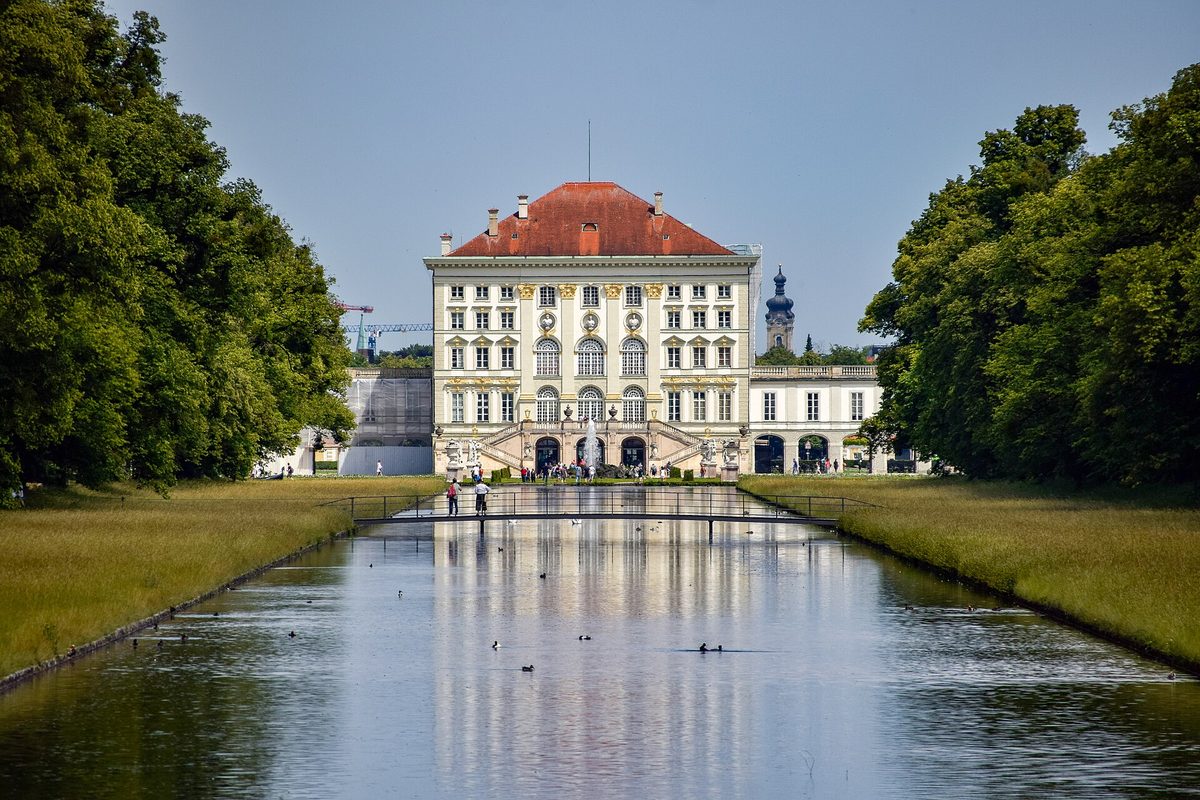
Foto: Photographer: Mosbatho · CC BY 4.0 · Wikimedia Commons

The Nymphenburg Palace opening hours follow two half-years. From April to 15 October the palace is open daily from 9am to 6pm; from 16 October to March only from 10am to 4pm, six hours instead of nine. Last admission everywhere is 30 minutes before closing, which on a short winter afternoon is the difference between a visit and a wasted trip. The whole estate is closed on 1 January, Shrove Tuesday, and 24, 25 and 31 December.
What matters more is what does not open at all in the winter half-year: the four park pavilions. Amalienburg, Badenburg, Pagodenburg and the Magdalenenklause are shut from 16 October to March, and with them goes the part of the estate that locals often rate higher than the palace. The Sckell exhibition and the historic pump houses are summer-only too. Come in January and you get the main building, the Marstallmuseum and the park. That is the whole list.
Two current restrictions on top of that. The lacquer cabinet in the Electress’s apartment (room 13) is closed for restoration until autumn 2026; every other state room can be seen without limitation. And the fountain in the Great Parterre stays out of service through 2026 while the water wheel in the Grünes Brunnhaus is repaired. The remaining fountains run from Easter to mid-October, daily 10am–12pm and 2pm–4pm.
Nymphenburg Palace tickets: when the combined ticket pays
The combined “Nymphenburg” ticket costs 20 € from 1 April to mid-October and 16 € from mid-October to 31 March, or 18 € and 14 € reduced. It covers the palace, the Marstallmuseum with the porcelain collection, and the park pavilions. Bought separately those three come to 24 € in summer, so the ticket saves 4 €, but only if you actually get round all three.
Nymphenburg Palace tickets for a specific day and time can be booked online in advance, which on a summer weekend is worth doing: the timed slots are what runs out, not the building.
In winter that sum turns over. The pavilions are closed, so the ticket really only covers two sites worth 18 € together, and the saving shrinks to 2 €. If you only want to see the main building in the winter half-year, the single 10 € ticket is cheaper. Children and young people under 18 pay nothing at any of the seven sites.
Two practical points about Nymphenburg palace tickets that regularly cause trouble at the gate. The palace is timed-entry only; the Marstallmuseum and the pavilions are not. And the pavilion ticket is not sold at the pavilions; you buy it at the palace or Marstallmuseum desk, or online. Walk into the park first and you will be walking back. An audio guide for the main building costs 3.50 € and comes in 10 languages; there are no scheduled guided tours.
Nymphenburg Palace Park is free, but the gates close early
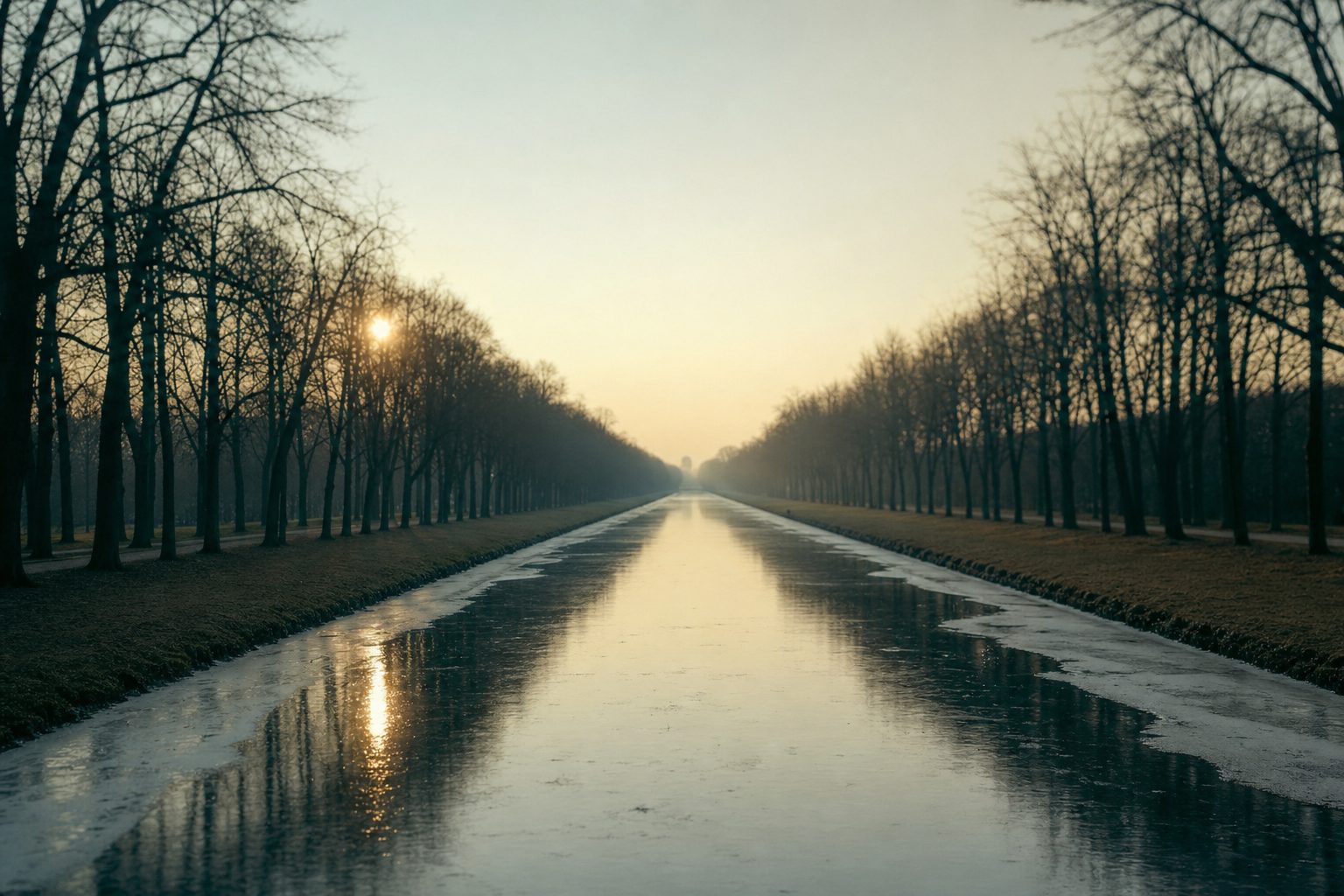
Nymphenburg Palace Park is open to anyone without a ticket, which is the real reason the estate fills half a day even if you never buy anything. It runs a good two kilometres west from the palace, with the canal cutting dead straight through the middle and an English landscape garden on either side: lakes, streams and the four pavilions. The main gate opens at 6am all year. It closes at 9.30pm from May to September, 8pm in April and October, and already at 6pm from November to March. The other gates close half an hour earlier.
One thing about the park surprises most visitors: it has been open to the public since 1792, long before that was normal anywhere else. In practice it means a winter day here is still worth it. The park is open, the canal freezes in cold years, and ice stock shooting on it has a following of its own. Just without the pavilions.
The museums around the palace
The Marstallmuseum in the southern courtyard buildings holds the state coaches and sleighs of the Bavarian electors and kings, including those of Ludwig II. Upstairs in the same building hangs the Nymphenburg Porcelain Museum with the Bäuml collection. And this is where the most common mix-up on the estate happens. The museum porcelain is in the Marstallmuseum, not at the manufactory. The manufactory at Nördliches Schlossrondell 8, 80638 München is a working business with a shop, not a museum with an admission ticket.
Two more museums sit in the same crescent but belong to other bodies and need their own tickets. The Museum of Man and Nature in the north wing is the cheapest thing on the estate at 3.50 €, or one euro on Sundays; it closes on Mondays and does not take cards. The Munich Botanical Garden on the northern edge of the park costs 5.50 €, with an exception hardly anyone knows about: in the winter half-year the outdoor garden is free and you only pay for the glasshouses.
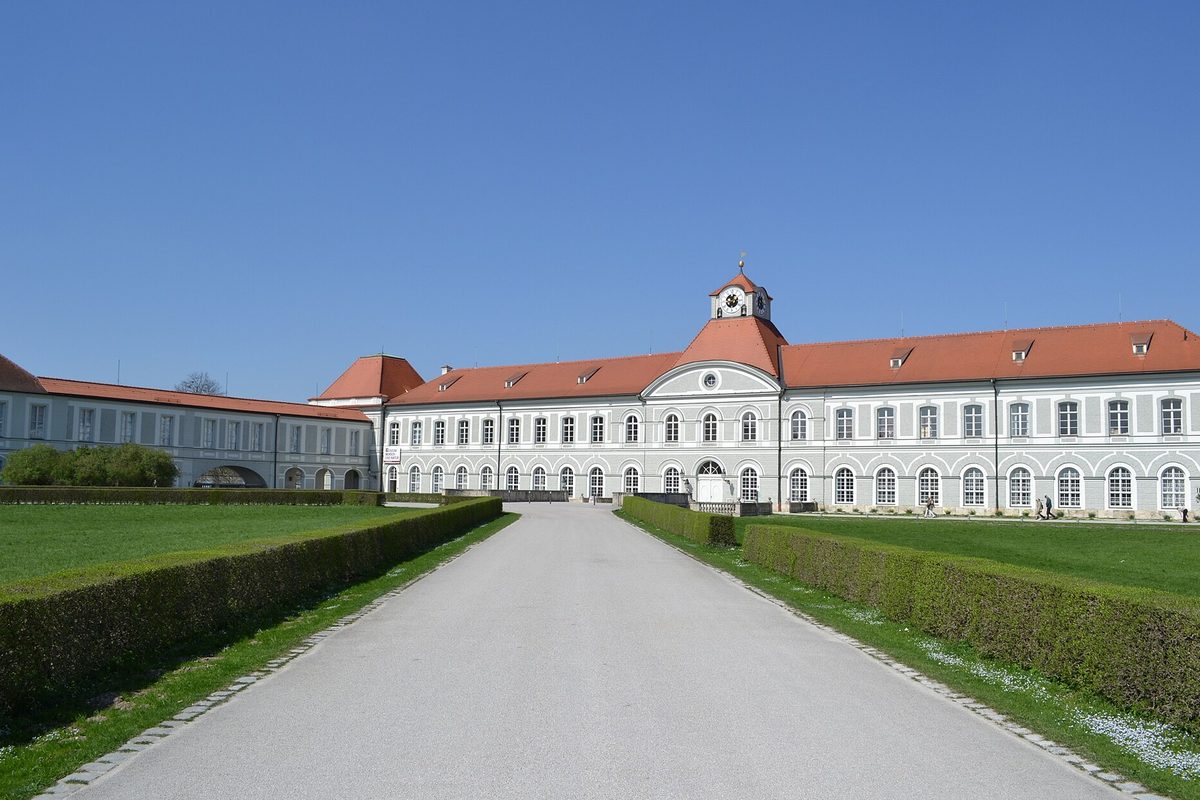
Foto: High Contrast · CC BY 3.0 de · Wikimedia Commons

Getting there
Getting there and parking
Two equally good routes by public transport: S-Bahn to Laim, then the bus to Schloss Nymphenburg, or U-Bahn to Rotkreuzplatz, then the tram to Schloss Nymphenburg. Both end at the palace crescent. By car there are about 450 free spaces and 8 coach bays, which on a summer Sunday is not always enough, and the tram is then the safer bet.
One note for planning the rest of the day: the Königlicher Hirschgarten, the largest beer garden in Europe with around 8,000 seats, lies about a kilometre southeast of the palace, roughly a quarter of an hour on foot and with an S-Bahn station of its own. Palace, park and beer garden combine into a single afternoon without changing trains.
From 1664 to today
Nymphenburg was not built in one go. It grew out of a single garden pavilion over more than two centuries, which explains its unusual shape: a central block with wings added again and again, and in front of it a crescent of pavilions that was meant to become a whole town.
- 1662After ten years of marriage, the Bavarian electoral couple Ferdinand Maria and Henriette Adelaide of Savoy finally have an heir, Max Emanuel.
- 1663Ferdinand Maria gives his wife the Kemnat estate west of the residence city; open fields, two hours from Munich at the time.
- 1664Building starts to plans by Agostino Barelli, the architect of Munich’s Theatinerkirche. At first it is a single cubic pavilion.
- c. 1679The first version of the “Lusthauß Nymphenburg” is essentially finished.
- from 1701Max Emanuel adds two pavilions to the north and two to the south under Henrico Zuccalli, and has a canal dug to bring water from the Würm.
- 1704–1715The War of the Spanish Succession forces Max Emanuel out of Bavaria and work stops for eleven years.
- from 1715Joseph Effner and the Parisian garden architect Dominique Girard draw the master plan: the crescent, the circular wall, five pairs of pavilions.
- 1731–1739François Cuvilliés the Elder builds the Amalienburg, the finest thing on the estate and a high point of European rococo.
- 1745–1777Under Max III Joseph the great hall gets its present decoration, and the porcelain manufactory moves into the front crescent.
- 1792Elector Karl Theodor opens the park to the public.
- 1804–1823Friedrich Ludwig von Sckell reshapes the baroque garden into a landscape park. The canal, the cascade and the parterre stay.
- 1825Max I Joseph, the first king of Bavaria, dies at Nymphenburg.
- 1845Ludwig II is born here on 25 August.
- 1865The neoclassical monopteros replaces two wooden predecessors by the Großer See.
Two entries in that list explain what you actually see. The War of the Spanish Succession interrupted construction for eleven years; when Max Emanuel returned from Paris in 1715 he brought French-trained artists with him, so the second phase looks nothing like the first. And the crescent was designed as the centre of a planned “Carlsstadt” that was never built, which is why it stands slightly adrift in the landscape today.
In short
Common questions
How much does Nymphenburg Palace cost?
10 € for the main building alone, 9 € reduced. The combined ticket for palace, Marstallmuseum and park pavilions is 20 € in the summer half-year and 16 € in winter. Under-18s go free.
Do you need a ticket for the park?
No. Nymphenburg Palace Park is free. You only pay for the buildings inside it: the four pavilions, and those only in the summer half-year. The main gate opens at 6am and closes between 6pm and 9.30pm depending on the season.
What is closed in winter?
From 16 October to March the four park pavilions are shut, along with the Sckell exhibition and the historic pump houses. The palace and Marstallmuseum stay open on shorter Nymphenburg Palace opening hours, 10am to 4pm, with last admission at 3.30pm. The park is open all year.
Where is the porcelain collection, in the palace or at the manufactory?
In the Marstallmuseum. The Nymphenburg Porcelain Museum is on its upper floor and is included in the Marstallmuseum ticket. The manufactory in the northern crescent is a working business that sells porcelain; it is not a museum you buy a ticket for.
Can you park at the palace?
Yes, around 450 free car spaces and 8 coach bays at the crescent. They fill up on summer weekends, and the tram to Schloss Nymphenburg is quicker then.
Prices, opening hours and restrictions as of August 2026, taken from the Bavarian Palace Department, the Bavarian Natural History Collections and the manufactory. Times and prices change; check the operator’s own page before you travel. Diese Seite auf Deutsch.